Conscientious sales engineer with demonstrated experience working in the machine and parts manufacturing industry. Ability to independently manage sales operations for commodities (engineering and manufacturing) and proficiency in quality customer service, international trade, and professional engineering project solution support. Great energy and great love into learning about processing, manufacturing.
For the University of Illinois Urbana-Champaign (UIUC)’s iRobotics team, engineering isn’t just a classroom subject—it’s a full-contact sport. As part of the ‘27 Combots Team, Laurie and her teammates set out to design and build a combat robot tough enough to survive the arena at UIUC’s Robobrawl competition. But they needed more than just ideas—they needed high-quality, custom-machined parts to make it happen.
The team’s design called for precision CNC components:
Motor mounts to hold the drive system securely
A weapon pulley to transfer power efficiently
A heavy-duty weapon capable of taking (and giving) a beating
“We didn’t have the capability to machine these parts ourselves,” Laurie explains. “The strength and durability requirements were beyond what we could achieve with our student workshop equipment.”
The team needed CNC-machined aluminum and steel components with exacting tolerances. These weren’t just functional parts—they were the difference between victory and a pile of scrap metal in the arena.
The Search: Learning from Experience
Rather than starting from scratch, Laurie did what smart engineers do: she asked around. The combat robotics community is tight-knit, and word travels fast about suppliers who understand the unique demands of their sport.
“We learned about XCD through previous teams’ experiences,” Laurie recalls. “Other combat robotics participants had good things to say about the company, so we decided to reach out.”
The reputation was built on three key factors that mattered most to student teams:
Manufacturing quality that could withstand arena combat
Competitive pricing and sponsorship opportunities crucial for student budgets
Familiarity with the unique needs of robotics teams
LURA, the Leeds University Rocket Association, used XCD’s 5-axis CNC machining and turn-mill compounding techniques to create intricate engine parts essential for their victory in the National Race to Space Propulsion Competition.
Challenges
1. Tight Deadline: The two-week span posed a challenge for delivering intricate parts.
2. Intricate Design: Rocket engine parts, especially combustion chambers, were deemed “manufacturable”. Besides, there are many oblique holes and grooves.
3. Tight Tolerance: The project required a challenging precision of +/-0.07 mm.
4. Material Issues: Unique thermal needs dictated using unconventional materials, especially in the combustion chamber.
Solutions
XCD employs 5-axis CNC machining and turn-mill compounding techniques to accurately machine complex geometries, such as oblique holes and grooves.
The client, an emerging wellness brand, set out to develop a high-quality, travel-friendly neck massager tailored to young professionals. Their vision was to blend relaxation, aesthetic appeal, and ergonomic design into a single, stylish product. With a deep understanding of their target audience—modern office workers under constant pressure—they wanted to offer a portable relaxation solution that fits seamlessly into daily routines and personal style.
However, turning this concept into a tangible product required a partner who could go beyond prototyping. The client needed an agile team that could handle design iteration, material optimization, mass production readiness, and ensure premium quality throughout.
That’s where XCD stepped in.
Understanding the Vision
The client approached us with a clear vision: to create a neck massager that not only delivers an exceptional relaxation experience but also doubles as a fashion accessory. The target users were young professionals—especially women—who spend long hours at a desk and seek a high-quality, stylish solution to relieve neck tension anytime, anywhere.
Instead of building just another massager, the client wanted a product that could fit effortlessly into a modern lifestyle: portable, elegant, and practical enough to use on the go. It had to feel like wellness and look like design.
Design Objectives
Combines a soothing massage experience with a stylish, modern design
Balances portability with visual appeal
Blends aesthetics and functionality. Not just good-looking, but also user-friendly
Ergonomically designed for maximum comfort and usability
Andrea, a dedicated mechanical engineer from Italy, utilized XCD 5-axis CNC machining to produce a full-body passive exoskeleton that boosts human strength and minimizes physical strain.
Challenges
Multiple machining surfaces, right angle U-shaped groove, oblique hole groove
Solutions
XCD’s advanced 5-axis manufacturing capabilities proved instrumental in fabricating the exoskeleton components with utmost precision.
Introduction
Driven by his passion for engineering, a passionate mechanical engineer from Italy, Andrea Piccinno, ventured into an expedition to bring the iconic “Iron Man Suit” to life. Andrea dedicated his spare time to turning this extraordinary vision into a reality.
The “Iron Man Suit” represents the epitome of human-machine integration, with its sleek design, advanced functionalities, and incredible capabilities. Andrea’s journey began with a deep fascination for exoskeleton technology and a desire to explore its potential. With the urge to push the boundaries of human-machine interaction, he delved into extensive study and investigation of the exoskeleton field.
He immersed himself in research, exploring existing technologies and scientific literature to understand the intricacies of exoskeleton design, functionality, and applications. Andrea and XCD combined their passion for innovation and commitment to excellence to transform this sci-fi fantasy into a real marvel.
As Andrea Piccinno progressed in his journey to develop the “Iron Man Suit,” he encountered a crucial turning point where his prototyping process using 3D printing reached its limits. 3D printing had served as an invaluable tool for preliminary testing and joint setup. However, functional testing and the need for structurally robust components required a different approach.
To achieve a higher level of readiness for testing and ensure the exoskeleton’s reliability and performance, there was a need to fabricate stressed components in aluminum alloy. This is where CNC machining emerged. Its ability to produce complex geometries and tight tolerances made it the optimal manufacturing method. In pursuit of a reliable and efficient CNC machining solution, Andrea collaborated with XCD, a trusted CNC Machining service provider.
Andrea sought CNC machining services for four critical components of the exoskeleton: the lats and deltoids. These components played a pivotal role in the exoskeleton’s functionality, bearing significant stress and contributing to the overall structural integrity of the suit. Andrea used XCD’s user-friendly quotation platform to initiate the collaboration process.
Here, he provided the necessary 3D models and 2D drawings of the components, along with the specifications required for proper assembly. This included features such as threaded connections, bearing slots, and mounting elements for elastic.
The aerospace industry is known for its rigorous standards and the perpetual need for innovation. Evoskil, a pioneering firm specializing in upgrade kits for ultralight aircraft, aimed to make a significant mark in the industry by introducing its innovative kits. But with great innovation comes a set of challenges. The collaboration between XCD and Evoskil is a testament to how two companies, driven by a common purpose, can conquer the most formidable challenges.
XCD’s prowess in CNC machining, combined with Evoskil’s visionary design, led to the rapid creation of essential parts. Using durable materials like aluminum and stainless steel, the parts were produced to perfection. Some even received a black matte oxide finish to meet specific surface requirements.
For Evoskil, the results were more than satisfactory. Not only were they able to validate the design and functionality of their product, but they also found a long-term ally in XCD. This collaboration ensured that the dreams of enhancing ultralight aircraft kits saw the light of day.
XCD proudly supports Rennteam Stuttgart by manufacturing 2 mainbar components and over 80 Aluminum inserts. Our precision engineering ensures they’re ready to conquer the Formula Student competitions, giving the team a winning edge.
Challenges
1. Machining challenges: Thin-wall mainbar part, holes with tolerance, irregular shape, different machining surfaces, ease of distortion
2. Tight delivery schedule
Solutions
XCD employs advanced 4-axis CNC machining and CNC turning-milling compound machining techniques to guarantee that all part requirements are met with precision and excellence. Our robust supply chain ensures that we can maintain a tight delivery schedule, making certain that your project stays on track and is delivered promptly.
Introduction
Rennteam Stuttgart is a highly successful team from the University of Stuttgart, Germany. Renowned for their record-breaking victories, groundbreaking designs, and unmatched engineering acumen, this team geared up for a game-changing venture in Formula Student in 2023.
Their aspirations are nothing short of extraordinary, including the development of a cutting-edge hybrid powertrain, the optimization of weight and stiffness, and the introduction of self-designed brake calipers to elevate both performance and safety.
To help them bring these dreams to fruition, XCD proudly steps in as the sponsor of the crucial racing components required to make this event an undeniable success.
Components like the mainbar form the baseplate for the pedal box. Aluminum inserts for the carbon fiber suspension are also critical to the overall success of the racecar. These parts are needed to withstand extreme forces, reduce weight for improved performance, and ensure the reliability required for the endurance discipline.
In their quest for a manufacturing partner capable of delivering high-precision components with fast turnaround times, Rennteam Stuttgart discovered XCD. The decision to choose XCD has a stellar reputation in the manufacturing sector. The exceptional track record for quick production times and consistently high-quality output caught the attention of the Rennteam Stuttgart. This made XCD a compelling choice for this critical partnership.
Online Platform: XCD’s user-friendly online platform streamlined the manufacturing process. The instant quotation system gave Rennteam Stuttgart rapid feedback on machining possibilities, allowing for quick decision-making and efficient communication.
DFM Analysis: XCD’s expertise in Design for Manufacturing (DFM) analysis played a pivotal role. Our engineers provided valuable feedback, suggesting design modifications that simplified the milling process and contributed to cost savings. This collaborative approach ensured that the parts met and exceeded Rennteam Stuttgart’s exacting standards.
Real-Time Tracking of Orders: The real-time tracking of orders added a layer of transparency to the manufacturing process. Rennteam Stuttgart could monitor the progress of their components, providing peace of mind and enabling effective project management.
Part Quality: XCD’s commitment to delivering high-quality parts was evident in every aspect of its production. The precision and attention to detail in the manufacturing process ensured that the components met the stringent requirements of Rennteam Stuttgart. This contributes to the overall safety and performance of the racecar.
Lead Time: One of the top concerns for Rennteam Stuttgart was the lead time. XCD’s self-owned factories and efficient production processes allowed us to meet the team’s demanding timelines. The ability to manufacture parts in minimal time was a decisive factor that contributed significantly to Rennteam Stuttgart’s success in Formula Student competitions.
Arco Aria, a seasoned tether car enthusiast, turned to XCD to help with custom machining for his high-performance tether car engines. Arco needed precision-engineered parts for his modified nitro engines, but as a hobbyist with a tight budget, he also sought affordable, small-batch manufacturing solutions. XCD’s online platform and expert support made it the perfect partner for his project.
Arco needed help with CNC machining parts for his tether car modifications, particularly the crankshaft and intake systems. With XCD, he found a reliable partner who could deliver high-quality, precision parts in small quantities, which was critical for his low-budget but high-performance builds.
Arco used XCD’s easy-to-navigate online quoting platform to get instant quotes and DFM analysis. The ability to track orders and receive updates from his project manager, Olivia, made the entire process fast and transparent. Arco was able to get the custom parts he needed—like custom steel bearing housings—without compromising on quality or speed.
Outstanding Results
Thanks to XCD, Arco successfully modified his tether car’s engine, including turning the crankshaft and designing a new intake system for improved efficiency. The parts met his tight tolerance requirements, and the quick turnaround time ensured his projects were ready on schedule.
The cost-effective, small-batch manufacturing allowed Arco to stay within his budget while achieving high-quality results. As a result, he’s set for the 2025 tether car season, with plans to show off his car at the European Championship in Lithuania.
XCD’s ability to handle specialized, low-volume CNC machining with precision and speed made a big difference in Arco’s racing prep.
The VR industry is rapidly evolving, demanding hardware that bridges immersive experiences with practical usability. A pioneering VR shoes project recently sought to solve a critical challenge: enabling natural, unrestricted movement in virtual environments while keeping users within a confined physical space.
To achieve this, the team required high-quality, functional prototypes of complex components that mirrored production-grade standards.XCD, with its expertise in vacuum casting and 3D printing, stepped in to deliver rapid, cost-effective solutions that propelled the project from concept to reality.
The project’s success hinged on producing durable, aesthetically refined parts capable of withstanding rigorous testing.
XCD’s vacuum casting technology emerged as a game-changer, enabling the creation of components with smooth, layer-free surfaces and robustness comparable to injection-molded parts. This method was prioritized for critical structural elements, ensuring material versatility (including silicone-based urethanes and ABS-like resins) and a premium finish.
For less complex parts, 3D printing provided rapid iterations, reducing both time and cost during the design optimization phase.
Key Contributions by XCD:
Vacuum Casting Precision: Delivered parts with superior surface quality and structural integrity, critical for user comfort and product durability.
Material Diversity: Over 20+ material options allowed the team to test properties like flexibility, wear resistance, and aesthetics.
Speed and Agility: Prototypes were delivered in 10 days, compressing development timelines and enabling faster validation cycles.
Technical Expertise: XCD’s engineers provided DFM feedback to optimize part geometry and reduce costs without compromising performance.
LURA, the Leeds University Rocket Association, used XCD’s 5-axis CNC machining and turn-mill compounding techniques to create intricate engine parts essential for their victory in the National Race to Space Propulsion Competition.
Challenges
1. Tight Deadline: The two-week span posed a challenge for delivering intricate parts.
2. Intricate Design: Rocket engine parts, especially combustion chambers, were deemed “manufacturable”. Besides, there are many oblique holes and grooves.
3. Tight Tolerance: The project required a challenging precision of +/-0.07 mm.
4. Material Issues: Unique thermal needs dictated using unconventional materials, especially in the combustion chamber.
Solutions
XCD employs 5-axis CNC machining and turn-mill compounding techniques to accurately machine complex geometries, such as oblique holes and grooves.
The parting line is not just a seam—it is the single most consequential tooling decision that dictates your CapEx, aesthetic quality, and the risk of severe flash. For senior mechanical engineers and NPI sourcing managers, treating parting line injection molding as a mere manufacturing byproduct guarantees compromised tooling and inflated piece prices. Instead, optimizing the parting line during the Design for Manufacturing (DFM) phase is a strategic engineering imperative. It determines the complexity of the CNC machining required to cut the tool, the necessity of expensive side-actions, and the ultimate dimensional stability of the molded component under high injection pressures.
The Physics of the Parting Line (Core & Cavity Mechanics)
In the thermodynamics and fluid mechanics of injection molding, the parting line (PL) represents the precise perimeter where the two halves of a mold—the A-Side (Cavity) and the B-Side (Core)—mate and establish a hermetic seal. This boundary dictates how the molten thermoplastic will be contained when subjected to cavity pressures that routinely exceed 10,000 PSI.
Mastering parting line design begins with establishing the “Line of Draw.” The line of draw is the strict geometric axis along which the two mold halves separate during the ejection phase. Every functional and aesthetic feature on the plastic component must be drafted relative to this axis, pulling away from the parting line. If a geometric feature runs perpendicular to the line of draw without an independent sliding mechanism, it creates a rigid undercut, effectively locking the plastic part inside the tool steel and rendering ejection impossible.
Planar vs. Non-Planar Parting Lines: The CapEx Impact
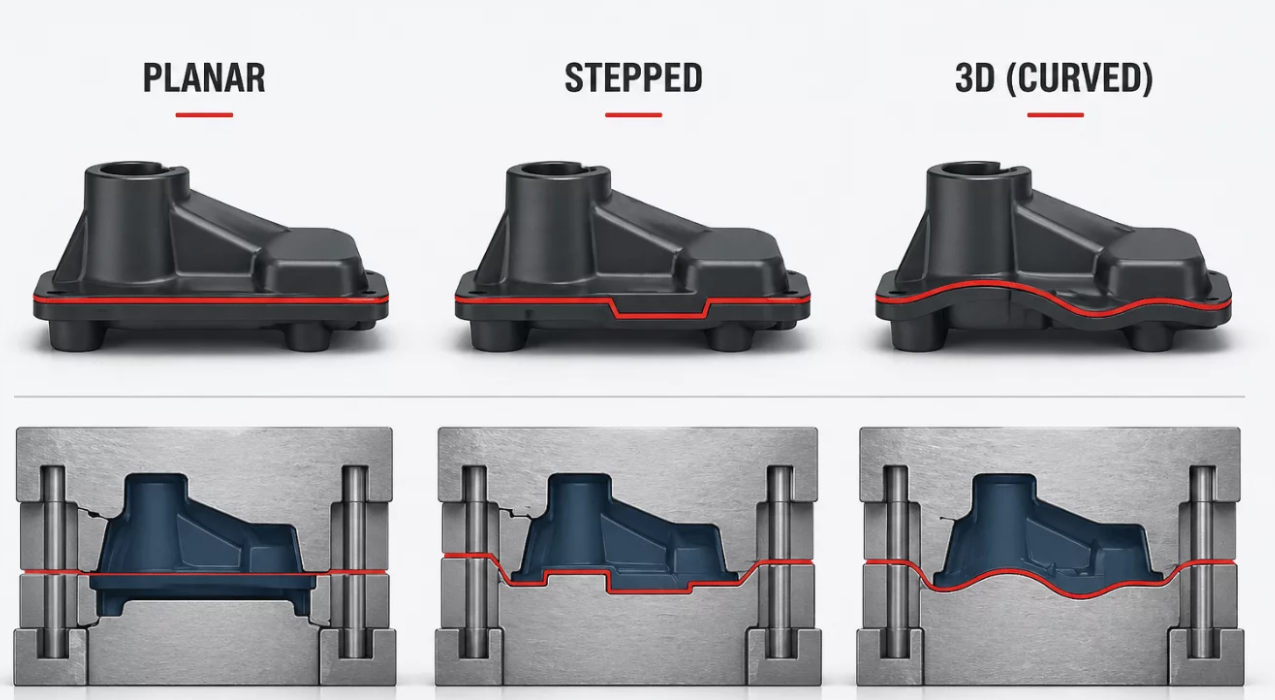
The specific geometry of your parting line directly correlates to the capital expenditure (CapEx) required to manufacture the injection mold. In a highly optimized injection molding DFM strategy, engineering the part to allow for a planar parting line is the ultimate objective.
The CapEx & Risk Matrix: Planar vs. Non-Planar Parting Lines
Parting Line Type
Tooling Cost (CapEx)
Machining Method (e.g., 3-Axis CNC vs. 5-Axis/EDM)
Keeping the parting line entirely flat on a single 2D plane is the holy grail of tooling economics. Planar parting lines require straightforward 3-axis CNC machining, allowing toolmakers to mill the mating steel surfaces rapidly and with exceptional precision. Because the A-Side and B-Side mate perfectly flat, the machine’s clamping tonnage is distributed evenly across the mold base. This yields the lowest tooling cost, accelerates lead times, and provides the tightest possible control over injection molding flash.
Stepped and 3D (Curved) Parting Lines
When dealing with complex ergonomic grips, power tool housings, or organic automotive bezels, planar lines are impossible. Stepped or 3D parting lines are forced to follow the undulating contours of the part’s geometry. The CapEx impact here is exponential. Machining a 3D parting line requires slower, highly complex 5-axis CNC milling. Furthermore, to achieve a perfect seal on sharp interior radii or complex curves, toolmakers are forced to use Electrical Discharge Machining (EDM) to slowly burn the mating surfaces into the hardened steel. This inevitably extends lead times by weeks and introduces a higher risk of tolerance stacking.
Mitigating Mold Mismatch: Interlocks and Side-Loads
The primary mechanical threat introduced by a non-planar parting line is “Mold Mismatch”. During the injection phase, the rapid influx of highly viscous resin generates an immense outward force. In a flat mold, the axial clamping force of the injection press easily counteracts this. However, when a mold features stepped or heavily sloped parting lines, that same injection pressure generates massive lateral shear forces, commonly referred to as side-loads.
These shear forces actively push the cavity and core blocks laterally out of alignment. If the mold shifts by even 0.05mm during the shot, the result is a visible, tactile step on the finished part and severe injection molding flash along the seam where the plastic escaped the cavity.
To absorb these lateral shear forces, elite tooling engineers must machine robust Heel Blocks and Tapered Interlocks directly into the mold base. These hardened steel interlocking features (typically drafted at 3 to 5 degrees) strictly guide the mold halves during the final millimeters of closure. They lock the A-Side and B-Side rigidly into place, neutralizing the side-loads before the resin is injected and guaranteeing the parting line remains perfectly sealed.
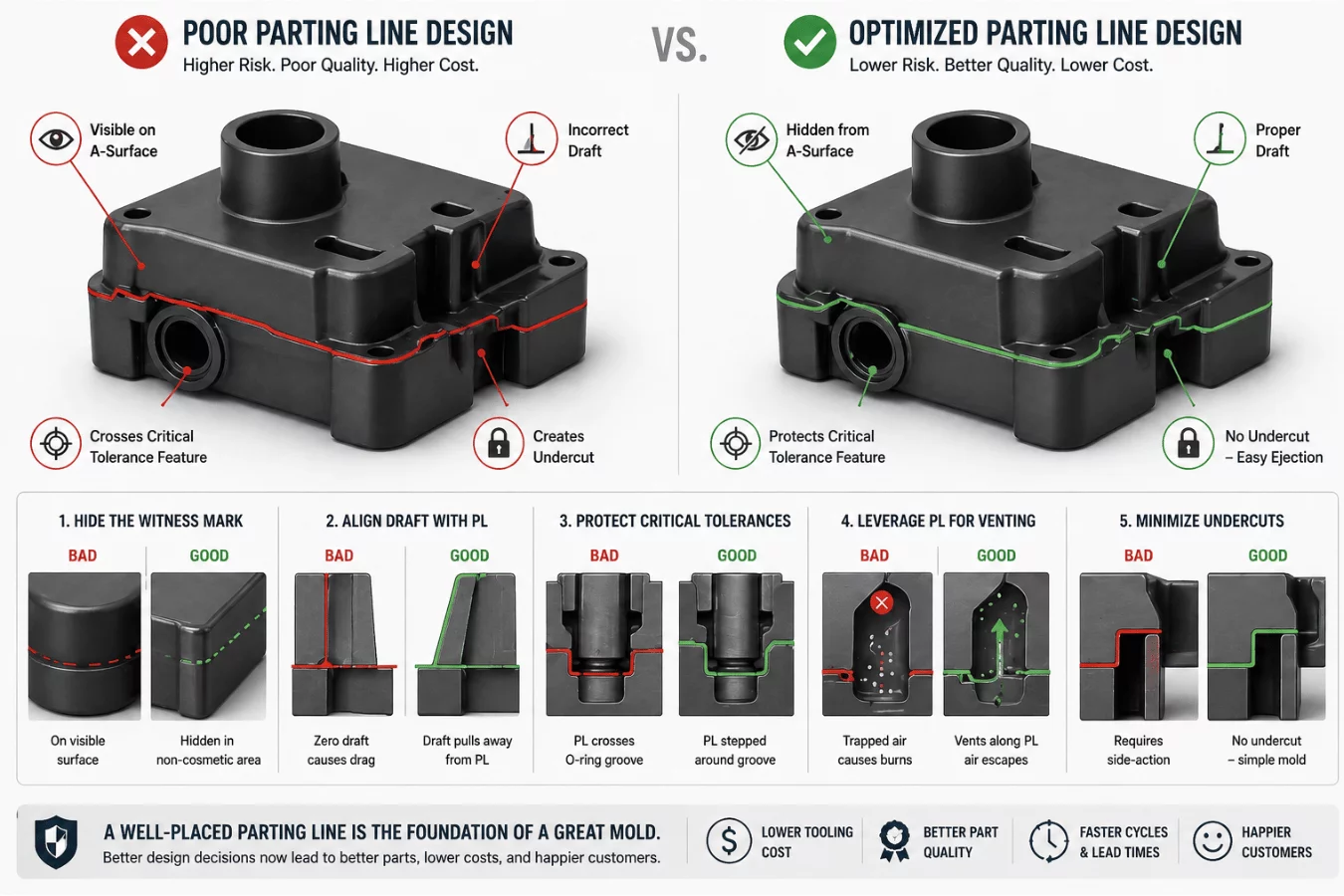
5 Golden Rules for Parting Line Design (DFM)
Elevating your parting line design requires moving beyond basic CAD geometry and applying strict manufacturing heuristics.
Rule 1: Hide the Witness Mark (Cosmetics)
Due to the microscopic gap between the two steel mold halves, every parting line will leave a witness mark (a faint seam) on the plastic part. Engineers must clearly differentiate between the cosmetic “A-Surface” (user-facing) and the functional “B-Surface” (internal). Never place a parting line across an aesthetic A-Surface. If forced to do so, the part will require expensive post-processing operations, such as manual sanding or media blasting, to erase the seam, which drives up the unit cost.
Rule 2: Align Draft Angles with the PL
Draft angles must originate from the parting line. The parting line should represent the widest cross-section of the drafted geometry relative to the line of draw. If the draft does not properly taper away from the parting line, the part will experience a zero-draft drag condition during ejection. This causes severe galling (scuff marks) on the plastic walls and significantly accelerates wear on the tool steel.
Rule 3: Protect Critical Tolerances
Parting lines should never intersect critical fluid sealing surfaces, O-ring grooves, or tight-tolerance bearing press-fits. If a stepped parting line crosses an O-ring groove, a mold mismatch of just 0.03mm will create an immediate leak path for fluids or gases. The parting line must be stepped around the groove, or the groove must be oriented entirely within the line of draw of a single mold half to ensure its circumference is machined as a single, uninterrupted geometric feature.
Rule 4: Leverage the Parting Line for Mold Venting
When molten plastic flows into a cavity, the ambient air inside must flow out. The parting line serves as the primary exhaust system for the mold. Tooling engineers strategically machine microscopic vents along the parting line to evacuate trapped air. These vents are typically machined to a precise depth of 0.01mm to 0.02mm for highly fluid resins like Nylon, allowing air molecules to escape while preventing the polymer chains from flashing. If the parting line is placed poorly and venting is restricted, the trapped air superheats, causing a “diesel effect” that leaves severe burn marks and structural voids in the plastic.
Rule 5: Minimize Undercuts
Intelligent parting line placement can eliminate the need for expensive side-actions (sliders and lifters). By creatively tilting the orientation of the part inside the mold relative to the line of draw, an engineer can often move an external hole, snap-fit, or protrusion so that it sits exactly on the parting line. This allows the feature to be formed simply by the two halves of the mold shutting together, instantly eliminating a $3,000 mechanical slider and compressing the total cycle time.
The Factory-Direct Advantage: Eliminating Parting Line Defects
Opaque “Black Box” manufacturing brokers routinely route your CAD files to the lowest-bidding, unvetted machine shops. Because they do not own the facility, critical tooling features like tapered interlocks and precise venting are often ignored. The result is predictable: T0 (first article) parts riddled with mold mismatch and severe flash, with the financial risk passed directly to the buyer.
To achieve aerospace-grade tolerances, NPI sourcing managers must bypass middlemen and partner with a fully integrated digital factory. XCD operates a 20,000㎡ factory-direct ecosystem engineered to eliminate parting line defects at the source:
AI-Driven DFM Analysis: We physically simulate the Line of Draw to strictly optimize your parting line placement before a single block of steel is milled.
Precision Tooling: By mathematically analyzing injection side-loads, our engineers proactively integrate tapered interlocks to guarantee ±0.05mm mismatch tolerances.
Unbroken Quality Control: Factory-direct execution ensures perfectly hidden witness marks, optimized venting, and extended tool life for high-volume production.
Ready to eliminate mold mismatch and secure your tooling ROI? Upload your CAD file to the XCD platform today. Get an instant DFM analysis from our engineering team to optimize your draft angles, perfect your parting lines, and secure a flawless manufacturing strategy.