Wire EDM Machining Services

Get precision wire EDM parts with accuracy and intricacy. Ideal for complex geometries that demand the highest standards. ISO 9001:2015, ISO 13485, ISO14001:2015, IATF 16949:2016 certified.

STEP | STP | SLDPRT | IPT | PRT | SAT files All uploads are secure and confidential
/01

High Quality
Parts

We use top-tier, regularly updated EDM machinery, ensuring clients receive workpieces machined to the highest standards of precision and accuracy. High precision with tolerance up to +/-0.001".

/02

Fast Lead
Time

XCD ensures quick project turnarounds as fast as 1 day without compromising on quality, thanks to our efficient wire EDM process and dedicated team.

/03

Online Ordering
and Quoting

XCD's online platform offers quick quotes and real-time order tracking. Streamline your projects with our efficient, transparent system for maximum convenience in the digital age.

Precision Wire EDM Machining with XCD

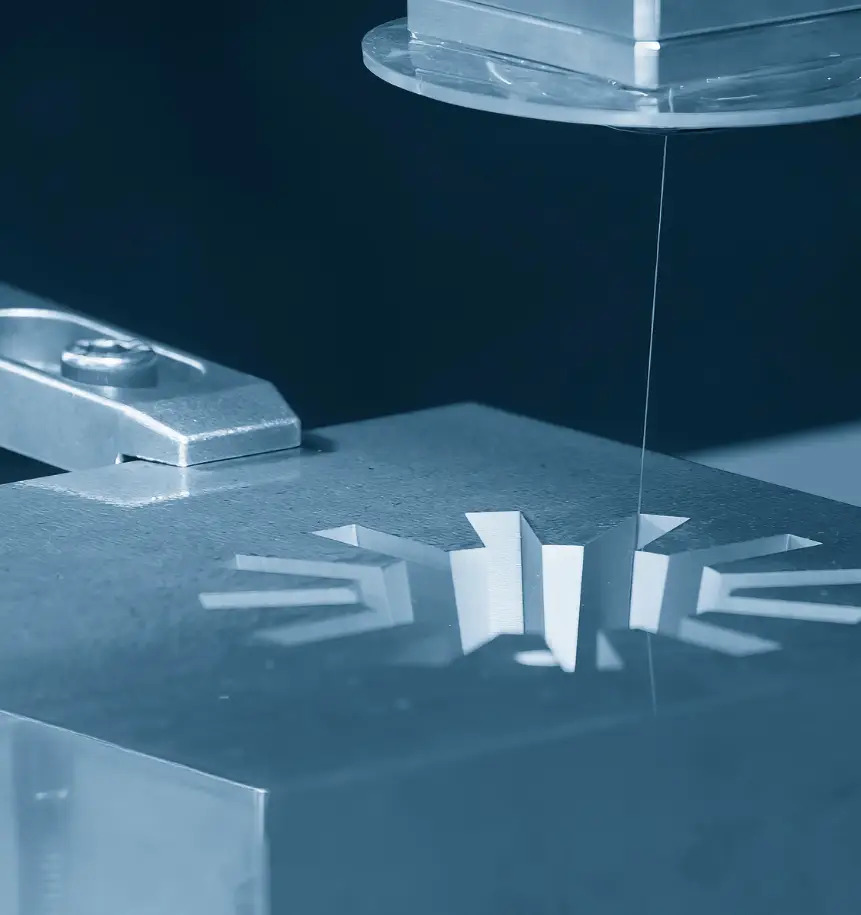
At XCD, we own the power of Wire Electrical Discharge Machining (EDM) to deliver precision-engineered parts to our clients. Wire EDM is a specialized machining process that utilizes electrical sparks to form intricate shapes and details in metals. This is done by creating a controlled electrical discharge between two electrodes, immersed in a dielectric fluid, which precisely cuts through the metal by melting and vaporizing it.

The true strength of wire EDM lies in its ability to machine complex contours and minute details in materials that are typically challenging to handle with traditional CNC machining. This includes heat-treated steels, superalloys, and other special metals. With wire EDM, we can achieve parts with incredibly tight tolerances and fine details such as narrow slots and small holes with unparalleled accuracy.

Our wire EDM services are a perfect match for applications requiring exacting precision. Whether it's creating components for aerospace, automotive, or intricate molds and dies, our technology ensures that every cut is precise and of the highest quality.

Get a Quote
Wire EDM Machining

How Wire EDM Machining Works

In wire EDM machining, a thin wire, precisely controlled and guided by computer systems, moves through a workpiece submerged in deionized water. The wire, acting both as a guide and electrode, uses electrical discharges to cut conductive materials accurately, resulting in parts with finely finished surfaces that seldom require further processing.

Step 1

Prepare the Workpiece

The first step is to securely clamp the workpiece onto the EDM machine's worktable, ensuring it remains stationary. The surface is then thoroughly cleaned and degreased to remove any contaminants. It's crucial that the workpiece material is conductive, as wire EDM requires a conductive medium to function.

Step 2

Establish the Electrical Discharge

Next, a thin metal wire is fed through the machine's guides and the wire and workpiece are submerged in a dielectric fluid, usually deionized water. An electrical potential is applied, causing the fluid to break down and allowing an electrical discharge (spark) to occur, eroding the workpiece's surface.

Step 3

Control the Wire Movement

The final step is to precisely control the wire's movement using a computer numerical control (CNC) system. The CNC guides the wire along a specific path, enabling it to cut complex shapes and profiles in the workpiece. The dielectric fluid is continuously circulated to remove debris and maintain temperature during the cutting process.

Wire EDM Materials

XCD's Wire EDM services efficiently machine a wide range of conductive materials, including tough superalloys and hardened steels, ensuring precise and durable components for demanding industries.

Stainless Steel

Stainless steel offers excellent corrosion resistance and strength, making it ideal for durable and long-lasting components in various industries, including medical and food processing.

Titanium

Titanium provides an exceptional strength-to-weight ratio and biocompatibility, making it perfect for aerospace applications and medical implants that require both durability and lightweight properties.

Steel & Hard Tool Steel

Steel and hard tool steel are known for their toughness and wear resistance, making them suitable for high-stress applications such as cutting tools, molds, and heavy-duty machinery components.

Aluminum

Aluminum is lightweight and highly machinable, offering good corrosion resistance and electrical conductivity. It is widely used in aerospace, automotive, and electronic applications.

Wire EDM Part Size Standards

XCD can handle diverse part sizes machined by wire EDM, from intricate micro components to larger, complex assemblies, ensuring precise adherence to dimensional standards.

  Small Parts (mm) Medium Parts (mm) Large Parts (mm)
Maximum Length 50 100 500
Maximum Width 30 70 300
Maximum Height 10 40 150
Minimum Thickness 0.5 1.0 5.0
Tolerance ±0.005 ±0.01 ±0.03

Get Wire EDM Machining Quotes

Our extensive network encompasses numerous machine shops, all equipped with cutting-edge wire EDM technology, ensuring vast capacity for both straightforward and intricate parts. This network is bolstered by certifications in ISO 9001:2015, ISO 13485, ISO14001:2015, IATF 16949:2016 guaranteeing that every part meets stringent quality standards. Don't hesitate! Get your quote today.

Applications of Wire Cut Parts

Wire EDM machining offers adaptability and precision, driving innovation and quality across diverse fields.

  • Aerospace: Produce components with complex geometries and precise tolerances that are essential for the high-performance demands.
  • Medical Devices: Allow for the manufacturing of intricate implants and surgical tools, ensuring safety and reliability.
  • Tool and Die Making: Ideal for creating detailed molds, dies, and fixtures that require exact dimensions and smooth surface finishes.
  • Automotive: Facilitate the production of high-precision gears and other critical components that demand tight tolerances.
  • Custom Manufacturing: Supporting bespoke manufacturing needs for specialized machinery and exotic material items.

Advantages of Wire EDM Machining

  • Precision and Accuracy: It is renowned for its ability to produce parts with extremely tight tolerances, often within +/- 0.0001 inches.
  • Complex Geometries: The method can create intricate and complex shapes that are difficult or impossible to achieve with traditional machining processes.
  • Material Versatility: It can cut through any electrically conductive material, including hard metals like titanium and hardened tool steel.
  • Smooth Surface Finishes: The process often requires little to no post-machining finishing because it can achieve surface finishes as smooth as a 16 microinch Ra.
  • No Contact Cutting: Since the wire never physically touches the part, there is no cutting force involved, eliminating mechanical stresses during processing.

Wire EDM FAQs

CNC machining has a wide range of applications across industries. In the automotive and aerospace sectors, it is used to fabricate precise engine components, structural parts, and other intricate elements. The medical industry leverages CNC for manufacturing devices, implants, and surgical instruments. CNC is also crucial in electronics, enabling the production of electronic housings, circuit boards, and connectors. Machine tool makers rely on CNC to create complex molds, dies, and machine components. Additionally, CNC is valuable for general custom part production, prototyping, woodworking, and more, allowing for consistent quality and high precision.
Advantages of CNC Machining Precision and Repeatability: CNC machining ensures high precision and consistent replication of parts, crucial for complex designs with tight tolerances. Reduced Human Error: The automated nature of CNC machining minimizes human error, enhancing the overall quality of production. Efficiency and Speed: Automation allows for faster production cycles, enabling quicker turnaround times than manual processes. Material Flexibility: CNC machines can work with a diverse range of materials, including metals, plastics, and composites, offering versatility across various applications. Software Integration: Advanced CNC software supports quick design changes and updates, facilitating rapid prototyping and easy customization. Cost-Effective for Large Runs: While setup costs are higher, per-unit costs decrease significantly with larger production volumes, making it cost-effective for mass production. Disadvantages of CNC Machining High Initial Costs: CNC machinery and its maintenance represent significant investments, making initial setup expensive, especially for small-scale operations. Skill Requirements: Operating CNC machines requires highly skilled personnel, which can increase training costs and limit accessibility. Less Cost-Effective for Small Runs: Due to setup and programming time, CNC machining may not be economical for producing small quantities of parts. Material Waste: CNC machining often involves subtractive processes, leading to more material waste compared to additive manufacturing. Limited to Material Hardness: Extremely hard materials can wear out CNC tools quickly, potentially increasing operational costs and downtime.
A machining center is a highly advanced CNC machine designed to handle a variety of machining tasks including milling, drilling, and tapping, all within a single setup. This integration enhances efficiency and accuracy by reducing the need to transfer parts between different machines. Machining centers are equipped with a tool turret or magazine that holds multiple tool options, enabling automatic tool changing under CNC control. This capability allows for rapid switching between operations, optimizing production flow. Typically, machining centers are used for complex parts that require precision machining from multiple angles, making them indispensable in modern manufacturing environments.
G and M codes are the programming languages used in CNC machining to control CNC machine tools. G-codes are primarily used for specifying the movements of the machine, such as linear interpolation, circular movements, and other specific functions related to the actual path of the tool. M-codes, on the other hand, handle machine functions that are not directly related to the path of the tool, such as turning the machine on or off, starting or stopping the spindle, and controlling coolant. Together, G and M codes provide a comprehensive set of instructions that CNC machines follow to produce parts accurately and efficiently.
CNC machining is renowned for its ability to achieve high precision and tight tolerances, essential for complex and detailed parts. Typically, standard CNC machining can maintain tolerances within ±0.01 inches (±0.127 mm). XCD defaults to standardized tolerances without special requirements. For even more precise requirements, advanced CNC machines can achieve tolerances as tight as ±0.0005 inches (±0.0127 mm) under optimal conditions. The achievable tolerance depends on several factors including the material, part geometry, size, and the specific type of CNC machine used. This capability makes CNC machining a preferred choice for industries that require highly accurate components, such as aerospace, medical, and automotive sectors.