Custom CNC Turning Services with
Instant Online Quote
XCD is a professional CNC
turning company providing precision CNC turning services for metal and plastic parts.
From rapid prototyping to full-scale production, we deliver custom CNC turning parts
with tolerances as tight as 0.005 mm and lead times as fast as 1 day.
Our CNC turning service enables the production of
high-precision CNC turning parts for a wide range of industries. Using advanced
CNC turning centers and experienced machinists, we provide reliable CNC turning
machining solutions for both simple and complex cylindrical components. Our CNC
turning capabilities allow us to deliver turned parts with high accuracy,
regardless of the complexity. You will get durable parts from flats to radial
and axial holes, slots, and grooves as fast as one day.
Our precision CNC turning lathes provide low-cost parts for simple and complex
cylindrical geometries. We also use Live tooling to create precise, complex
geometries for features like axial and radial holes, grooves, slots, and flats.
Full automation of these versatile machines allows us to produce hundreds of
similar dimensions easier, faster, and cost-effectively.
Accelerate product development with our CNC
turning machining services. We offer fast turnaround times and specialize in
quick production of high-quality prototypes and mold tooling, aiding your
design verification process.
Whether you need small batches or large-scale production, we can offer you both.
With stringent tolerance controls and comprehensive capabilities, we adapt to
your volume CNC turning parts, without compromising on quality.
XCD offers a comprehensive range of surface finishes for CNC turning services,
helping improve the appearance, durability, and functional performance of CNC
turned parts. These finishing options enhance surface roughness, hardness, and
corrosion resistance while minimizing visible tool marks produced during CNC
turning and live tooling operations.
As an ISO 9001 certified CNC turning company, XCD machines precision CNC turning parts to meet
strict dimensional tolerance requirements. Based on your design, our CNC lattes
can reach tolerances of up to ±0.005”. Our standard tolerances for
CNC milled metals is ISO 2768-m and ISO 2768-c for plastics.
Description
Maximum Part
Size
Typically up to 500 mm in
diameter and 1500 mm in length, though larger sizes can
be accommodated with specific equipment.
Minimum Part
Size
As small as 1 mm in diameter,
depending on the material and machining
setup.
General
Tolerances
Standard tolerances of
±0.01 mm; tighter tolerances down to
±0.005 mm can be achieved based on the material
and complexity of the part.
Lead
Time
Standard lead times range
from 3-7 days for small batches. Expedited services are
available, reducing lead time to 24-48 hours depending
on part complexity and material
availability.
CNC Turning Design
Guidelines
Recommended
Size
Radii
Minimum internal radius of
0.5 mm recommended. Larger radii (up to 3 mm or more)
can improve tool access and reduce stress concentrations
in the part.
Threads and Tapped
Holes
External and internal threads
can be precisely cut. Standard thread sizes from M1.6
and larger are feasible. Ensure a minimum thread length
of 1.5 times the diameter for stability.
Minumum Wall
Thickness
Maintain a minimum wall
thickness of 0.8 mm for metals and 1.5 mm for plastics
to ensure structural integrity without compromising the
machining process.
Text
Engraving should have a
minimum character height of 2 mm and a depth of at least
0.5 mm to ensure legibility after
machining.
Holes
Minimum hole diameter of 0.5
mm. For deep holes, maintain a diameter to depth ratio
of 1:10 to avoid tool deflection and ensure hole
quality.
CNC Turning Design Guidelines
Recommended Size
Radii
Minimum internal radius of 0.5 mm
recommended. Larger radii (up to 3 mm or more) can improve tool access and
reduce stress concentrations in the part.
Threads and Tapped Holes
External and internal threads can be
precisely cut. Standard thread sizes from M1.6 and larger are feasible. Ensure a
minimum thread length of 1.5 times the diameter for stability.
Min Wall Thickness
Maintain a minimum wall thickness of 0.8
mm for metals and 1.5 mm for plastics to ensure structural integrity without
compromising the machining process.
Text
Engraving should have a minimum character
height of 2 mm and a depth of at least 0.5 mm to ensure legibility after
machining.
Holes
Minimum hole diameter of 0.5 mm. For deep
holes, maintain a diameter to depth ratio of 1:10 to avoid tool deflection and
ensure hole quality.
Description
General
Tolerances
Metals : ISO
2768-m
Plastics : ISO 2768-c
Precision
Tolerances
XCD can
manufacture and inspect parts with strict tolerances according to your
drawing specifications and GD&T annotations, including tolerances
tighter than +/- 0.001 inches.
Min Wall
Thickness
0.5mm
Min End
Mill Size
0.5mm
Min Drill
Size
1mm
Maximum
Part Size
CNC Milling:
4000×1500×600 mm
CNC Turning: 200×500 mm
XCD is a trusted CNC turning
company, delivering reliable CNC turning services for customers across multiple
industries. With advanced CNC turning machining capabilities and experienced engineers,
we support everything from rapid prototyping to production-grade CNC turned parts.
/01
High Quality Parts
Our ISO-certified CNC machining produces precise, reliable parts with strict
inspection for fit and performance.
/02
Fast Lead Time
With local workshops and a network of CNC machine shops, we offer fast CNC
machining capabilities and quick turnarounds, including lead time as fast as 1
day.
/03
Engineering Support
Rely on our team for all your CNC machnining needs. Our specialists provide
support to maximize design efficiency and quality.
/01
High Quality CNC
Turning Parts
Experience unparalleled precision in each
undertaking. Our advanced milling processes ensure components adhere to
tight tolerances, as tight as ±0.01mm, resulting in seamless assembly
and operational excellence.
/02
Fast Lead Time
Speed up your manufacturing cycle with our
efficient CNC turning services. Supported by in-house workshops and modern
CNC equipment, we deliver fast lead times without compromising part accuracy
or surface quality.
/03
Professional CNC Turning
Engineering Support
No matter you whenever and whereever, navigate your
CNC milling projects with confidence. Our seasoned specialists offer
insightful guidance at every step, maximizing design optimization and output
quality.
How Does CNC
Turning Work?
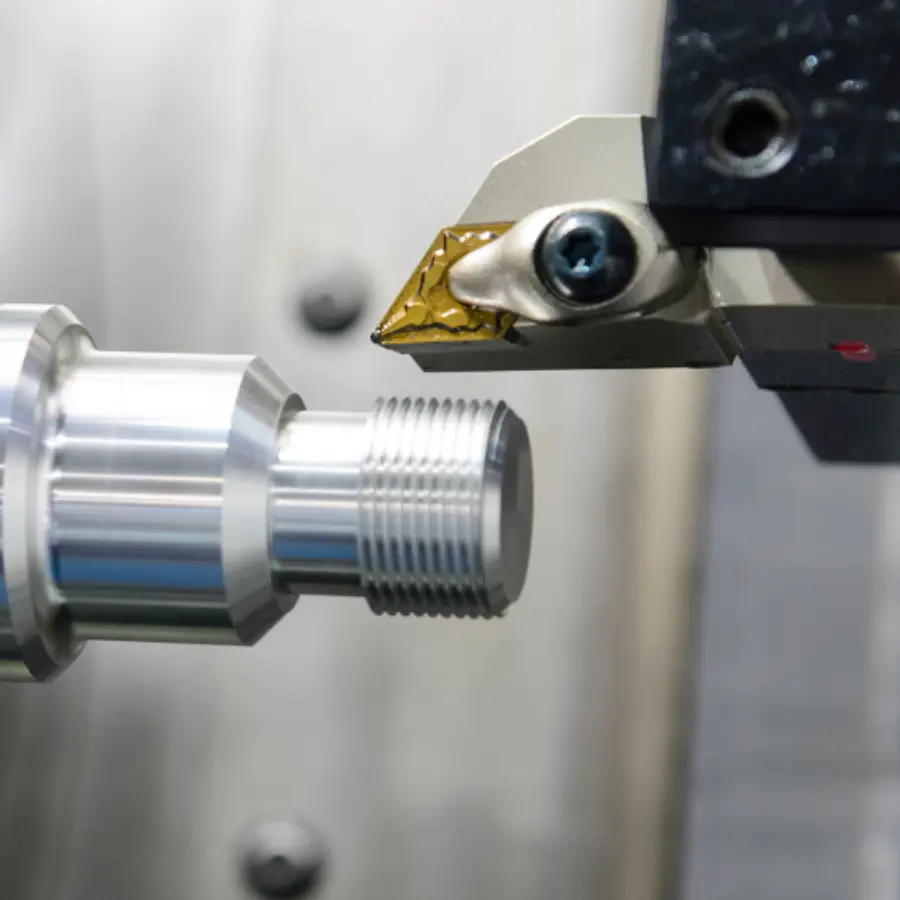
CNC turning is a subtractive manufacturing operation that uses
computer-controlled lathes to precisely shape material into
cylindrical parts. Initially, the design of the part is created
using CAD software and converted into instructions for the CNC
machine using CAM software. During setup, the correct cutting tools
are installed, and a cylindrical workpiece is secured in the
machine’s chuck, which holds and rotates the material.
As the machine operates, the workpiece spins at high speeds while the
cutting tools move along various axes to carve, cut, and shape the
material based on the program’s specifications. Operations
such as facing, threading, knurling, and drilling are performed
during this stage. A coolant is often applied to prevent overheating
and to wash away debris.
After machining, the part may undergo additional finishing processes
like sanding or polishing. The final step involves a thorough
inspection to ensure the part meets all the required dimensions and
tolerances. This process allows for high precision and
repeatability, making CNC turning ideal for producing complex parts
efficiently.
Advantages of CNC Turning
CNC turning offers several distinct advantages that make it a preferred method for
manufacturing precise cylindrical parts. Here are some of the key benefits:
High Precision – Delivers tight tolerances
and consistent quality for precision CNC turning parts
Fast Production – Automated CNC lathes
support quick turnaround and repeatable results
Material Versatility – Suitable for
metals and plastics used in CNC turning services
Applications OF CNC TURNING
As a leading turned parts manufacturer, XCD utilizes CNC turning to produce a variety
of precision components, often used in mechanisms where accuracy and fit are
critical. Here’s an overview of some typical parts made through this process:
Shafts and pins
Bushings and sleeves
Flanges
Knobs, dials, wheels, and rollers
These CNC turned parts are commonly applied in automotive, industrial equipment,
electronics, and automation systems.
Advantages
Advantages of CNC Turning
CNC turning offers several distinct advantages that make it a preferred method for
manufacturing precise cylindrical parts. Here are some of the key benefits:
Precision and Accuracy: Machines are capable of achieving
extremely tight tolerances, essential for components that must fit seamlessly
into complex assemblies.
Efficiency: Once programmed and set up, these machines produce
parts quickly and with consistent quality, often requiring minimal supervision,
which accelerates production cycles.
Flexibility: The ability to reprogram the machines for
different designs quickly makes them highly adaptable to varying production
needs, enhancing operational responsiveness.
Repeatable: The automated nature ensures that each part is
identical, even across large production volumes, crucial for maintaining quality
in mass production.
Reduced Labor Costs: Automation reduces the need for manual
intervention, cutting labor costs and minimizing human error, thereby enhancing
overall efficiency and cost-effectiveness.
Material Versatility: The machines handle a wide range of
materials, from various metals to plastics and composites, accommodating diverse
manufacturing demands.
Improved Safety: The enclosed, automated operation minimizes
human interaction, reducing the risk of accidents and promoting a safer
workplace.
Applications
Applications of CNC Turning
As a leading turned parts manufacturer, XCD utilizes CNC turning to produce a variety
of precision components, often used in mechanisms where accuracy and fit are
critical. Here’s an overview of some typical parts made through this process:
Shafts are fundamental in various machines, serving as axes or
pivots. Precision in diameter and surface finish is crucial for their
interaction with other mechanical parts.
Flanges connect pipes, pumps, or valves, requiring accurate
machining to ensure a secure fit and avoid leaks.
Bushings and Sleeves provide smooth surfaces for other parts to
move against or through, necessitating exact internal diameters and smooth
finishes.
Pins are small but vital for aligning or holding components
together, often needing precise dimensions to fit snugly into place.
Knobs and Dials are user interface elements for machinery and
electronic devices, where aesthetics and precise dimensions enhance usability.
Wheels and Rollers are integral to systems like conveyors,
where consistent shape and smoothness reduce friction and wear.
CNC Turning FAQs
Can you provide insight into your CNC machining capacity?
Certainly! At XCD, we have the capacity to manufacture over 10,000 diverse prototypes each month, ranging from straightforward to complex designs. Our production capabilities are supported by more than 200 state-of-the-art CNC machines. We also take pride in our team of over 100 skilled technical experts who ensure precision and quality in every project. This extensive infrastructure allows us to meet large-scale demands efficiently, making us a reliable partner for all your CNC machining needs. Whether your project is big or small, our resources are geared to deliver with excellence.
What tolerances could CNC machining reach?
CNC machining is renowned for its ability to achieve high precision and tight tolerances, essential for complex and detailed parts. Typically, standard CNC machining can maintain tolerances within ±0.01 inches (±0.127 mm). XCD defaults to standardized tolerances without special requirements. For even more precise requirements, advanced CNC machines can achieve tolerances as tight as ±0.0005 inches (±0.0127 mm) under optimal conditions. The achievable tolerance depends on several factors including the material, part geometry, size, and the specific type of CNC machine used. This capability makes CNC machining a preferred choice for industries that require highly accurate components, such as aerospace, medical, and automotive sectors.
What is machining center and how does it work?
A machining center is a highly advanced CNC machine designed to handle a variety of machining tasks including milling, drilling, and tapping, all within a single setup. This integration enhances efficiency and accuracy by reducing the need to transfer parts between different machines. Machining centers are equipped with a tool turret or magazine that holds multiple tool options, enabling automatic tool changing under CNC control. This capability allows for rapid switching between operations, optimizing production flow. Typically, machining centers are used for complex parts that require precision machining from multiple angles, making them indispensable in modern manufacturing environments.
What are the applications of CNC machining?
CNC machining has a wide range of applications across industries.
In the automotive and aerospace sectors, it is used to fabricate precise engine components, structural parts, and other intricate elements.
The medical industry leverages CNC for manufacturing devices, implants, and surgical instruments.
CNC is also crucial in electronics, enabling the production of electronic housings, circuit boards, and connectors.
Machine tool makers rely on CNC to create complex molds, dies, and machine components. Additionally,
CNC is valuable for general custom part production, prototyping, woodworking, and more, allowing for consistent quality and high precision.
Who is the father of CNC machining?
John T. Parsons is often credited as the father of CNC machining. In the late 1940s, Parsons developed the first numerical control techniques and applied them to the production of helicopter rotor blades. Working alongside engineer Frank L. Stulen, Parsons conceptualized the method of using punched tape to guide machine tools. This innovation laid the groundwork for the development of CNC (Computer Numerical Control) technology. Their pioneering work eventually led to the creation of the first CNC machines in the 1950s, which revolutionized manufacturing by improving the precision, efficiency, and repeatability of machining processes.